Seoul. Two palaces, two languages of power
Gyeongbokgung and Deoksugung tell different histories.
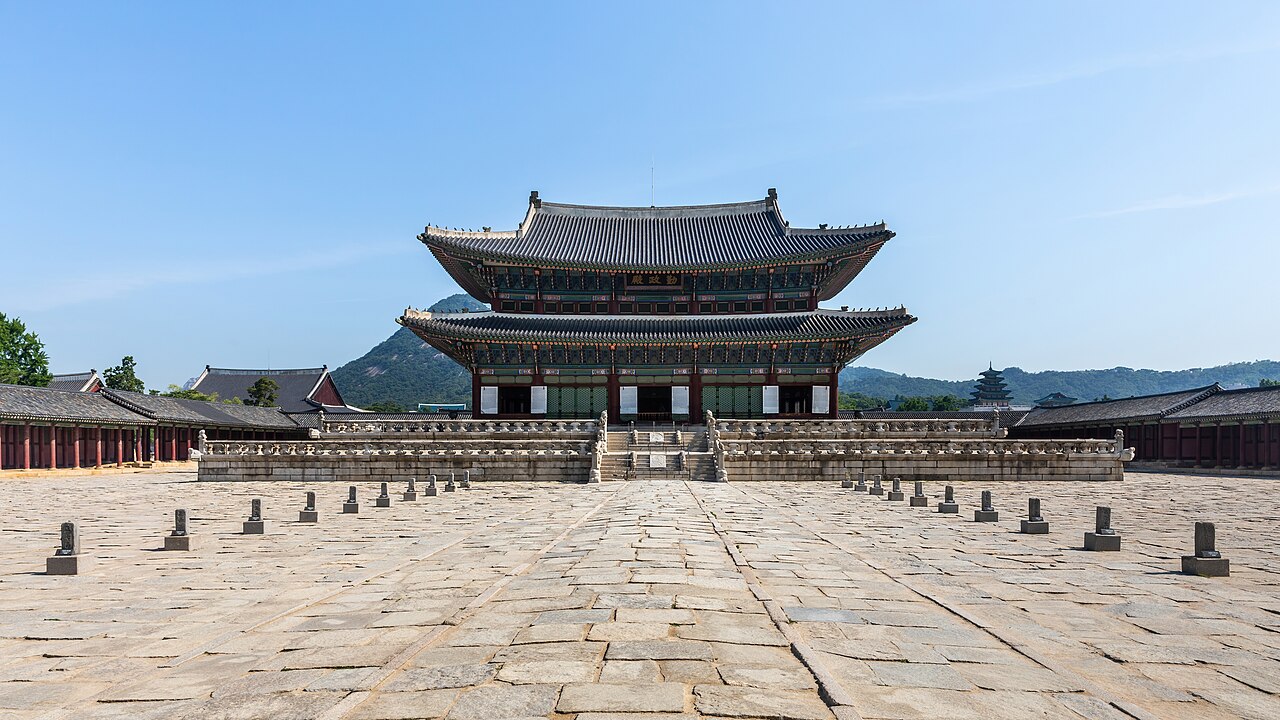
Photograph · credits
Basile Morin · Wikimedia Commons · CC BY-SA 4.0 · OriginalPhotograph, 2024; reduced display version. No endorsement implied.
Gyeongbokgung and Deoksugung tell different histories. The former was founded in 1395 as the main palace of the Joseon dynasty. Destroyed during the Japanese invasion of 1592, it remained in ruins for a long period; a major reconstruction was completed in 1867. Later demolition and modern restoration mean that the foundation date does not date every hall visible today.
When the Korean Empire was proclaimed in 1897, the second palace was called Gyeongungung. Gojong established his imperial court there. It received the name Deoksugung only in 1907, following his abdication. Keeping the names in sequence avoids making the site’s entire past appear imperial.
The complex also brings architectural languages together. The institutional history describes the introduction of Western-style buildings and dates the completion of the stone Seokjojeon Hall to 1910. That hall belongs to a later transformation of royal representation, rather than to a medieval original.
A useful comparison follows a particular building through its changing functions. Reconstruction can recover a historical arrangement while also becoming part of modern conservation history. That account is more informative than simply sorting everything into “old” and “new”.
Editorial notes2026-10-30
The stated claims and their references were checked. Editorial interpretation and exercises are not separate historical findings.
Reviewed with AI assistance. The stated claims and choice of sources were examined; this is not independent academic peer review or a guarantee that no errors remain.
Materials used in the reviewSources and further research
- Gyeongbokgung · palace history
An institutional source for the Korean route. Read it within the scope of the specific place, object or document.
- Deoksugung · from kingdom to empire
An institutional source for the Korean route. Read it within the scope of the specific place, object or document.
Prepare a lesson · 45 minResearch / Patronage
A teacher script, reading material, photocopiable worksheets and an assessment rubric — based on this entry.
One packet uses one PDF download. The teacher checks suitability for the class.About this entry and rights
Descriptive content was prepared with AI assistance. The entry states its review scope. RoyalBea is an independent editorial project. Catalogue descriptions do not imply a full reading of the books. Check the date, scope and rights attached to source materials.