From curiosity to a documented finding
Move from a search result to a catalogue reference, document and honest citation, including when no scan exists.
AI illustration · details
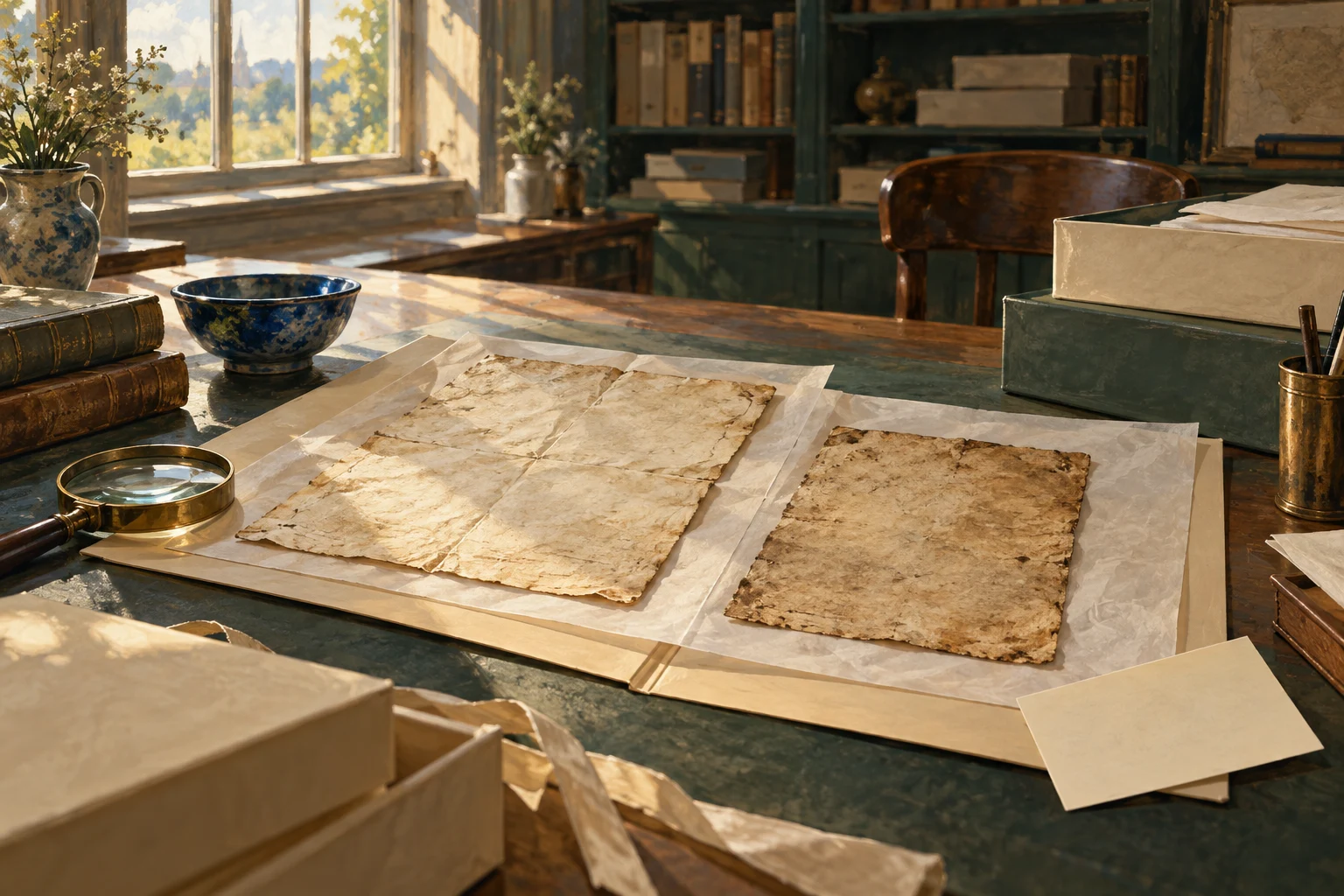
RoyalBea · AIAI illustration; the paper forms an imagined scene rather than reproductions of historical records.
A useful archival enquiry begins with a question that a particular record could answer. Instead of researching everything about a court, choose a person, action, place and date range. Note spelling variants and the language of the institution that may have created the record. A search engine recognises wording, not a person’s entire history.
Treat the first result as a signpost. Check the custodian, collection or series title, full reference and covering dates. A combined catalogue can describe records held elsewhere. A collection, file and individual page are different levels of description.
Discovery, Szukaj w Archiwach and national digital reading rooms connect descriptions with available material. Not every result has an image. An absent scan limits online access; no search result may reflect vocabulary, incomplete cataloguing or undigitised holdings. Write “This search found no corroboration”, rather than “The event never happened”.
When an image is available, inspect its beginning, end, numbering and neighbouring pages. An isolated extract may omit its author, date or a qualification that changes its meaning. OCR and transcriptions help locate words; compare difficult readings with the image.
A citation should let another researcher locate the same passage: custodian, reference, internal page or folio, document title or description, link and access date. Distinguish citing the original document from citing its catalogue description. In the latter case, call it a description instead of implying that you inspected the record.
End with three outcomes: a documented finding, an unresolved gap and the next action. Such a notebook remains useful even when a search produces no spectacular discovery.
Editorial notes2026-10-30
The stated claims and their references were checked. Editorial interpretation and exercises are not separate historical findings.
Reviewed with AI assistance. The stated claims and choice of sources were examined; this is not independent academic peer review or a guarantee that no errors remain.
Materials used in the review- The National Archives · citing records · https://www.nationalarchives.gov.uk/help-with-your-research/discovery-help/citing-records-national-archives/ ↗
- Szukaj w Archiwach · Polish descriptions and scans · https://www.szukajwarchiwach.gov.pl/ ↗
- Riksarkivet · Digital Research Room and NAD · https://sok.riksarkivet.se/ ↗
Sources and further research
- The National Archives · citing records
Record the archive, collection and reference. A page URL supplements the record reference rather than replacing it.
- Szukaj w Archiwach · Polish descriptions and scans
The NAC and archival institutions’ portal: collection and file descriptions, photographs, maps and copies of documents. A route into Polish monarchy, aristocracy and their social setting.
- Riksarkivet · Digital Research Room and NAD
The Swedish search service connects digitised records, indexes and the National Archives Database. Search people, institutions, places and dates, distinguishing a collection from a document.
Prepare a lesson · 45 minResearch / Patronage
A teacher script, reading material, photocopiable worksheets and an assessment rubric — based on this entry.
One packet uses one PDF download. The teacher checks suitability for the class.About this entry and rights
Descriptive content was prepared with AI assistance. The entry states its review scope. RoyalBea is an independent editorial project. Catalogue descriptions do not imply a full reading of the books. Check the date, scope and rights attached to source materials.